Showing posts with label japan. Show all posts

Tuesday, August 28, 2012

That one time in Japan I served food at a festival....

Finally another update in the "That one time in Japan" series!

This time is when I served food at Kashima Elementary's festival. I believe is was a fundraising festival, but to be honest, it was in December and I didn't speak much Japanese then.

I was woken up one Sunday morning and my host mom said she was going to a festival ( for Japanese learners, 祭り=まつり= matsuri) at the local elementary school and asked if I wanted to go. I said sure, figuring it'd be a quick trip and definitely not realizing what an interesting day it would prove to be.

Once we arrived, I took a look at the stalls, which were filled with your typical festival foods and some activities for the kids. After the typical gaijin in a small town-craze, I was roped into helping sell food with random people my host mom knew. I was helping sell two dishes - some kind of mochi ball-thing and soup. The food, as yummy as it was, was not the reason this day was so much fun.... it was the four ojiisan's I got to work with!

When people would come to buy food, they would obviously ask who this crazy blonde gaijin-san was, why I was there, where I was from, etc. One of the guys spoke decent English, so he would help translate for me. Their answers were either I was their daughter, their mistress, sister-in-law, wife, cousin, twin, and very rarely, an exchange student. Sometimes they would say things in English which caused some confused faces of customers, but everyone working at the booth knew the game and would laugh together.

It was one the funnest days I had in Japan, and definitely one I will not forget!
I only managed to get one photo that day, but it was definitely the most important - a photo with my host mom and the ojiisans! (click for larger image!)


It was during this festival that I apparently said I would do the Japanese Speech Contest (I don't remember this) but regardless, that story is for another time.

Wednesday, March 07, 2012

Kashima Shrine

I am finally able to post again!!! My computer's fan just stopped working. It was horribly stressful because I had just started looking for jobs in Baltimore, and then my computer suddenly wouldn't stay on for longer than 10 minutes. Luckily I was able to get it fixed for only $65.00!


In other news, today my car decided to stop working as well. In the absolute lack of luck that was today, one of my best friends came to my rescue and hopefully everything will go up from here.


Sometimes I really want to just know how many times in a two year time-frame can you hit rock-bottom, but things will get better eventually, just gotta keep swimming...

So onto a post I've planned and had written for awhile....

鹿島神宮
Kashima Shrine
All photos from : http://city.kashima.ibaraki.jp/kankou/1/zingu.html

Now, don’t call me biased or anything (though I totally am), but today I want to talk about 鹿島神宮Kashima Jinguu, located in Kashima-shi, Ibaraki-ken.

I got to visit this shrine a lot. So much so, I’ve memorized most of it - the pathways, the big, beautiful trees, the deer, the way the pathway felt kind of like quicksand after it rained. This shrine in particular means a whole lot to me.

The Kashima Jinguu shrine is one of the oldest in Japan.

Here’s a little history lesson about Kashima-shi: The original kanji for Kashima was 鹿(ka, “deer”)+島(shima, “island“). This kanji pairing is still used for many things in Kashima such as in the names of the “Kashima Antlers“ soccer team and the shrine. The official kanji pairing used now for the city, however, is 鹿嶋, which still means “deer island”. I’m not exactly sure why they changed the kanji because I could never get a clear answer other than “that sometimes happens in Japan”. Really? I could have never guess that myself. /sarcasm

This “deer island” theme carried over into many aspects of life in Kashima - the Antlers name came from it, their mascot was a pair of deer, the members prayed at the shrine together before every home match and hosted their championship parade there (which I totally skipped school for :] ), and there were many deer kept at this shrine (much more than I’ve seen in other places, such as in Hiroshima).

My school - Seishin Gakuen was located at the upper end of the shrine, so there were a few times during Long Home Room that we were able to walk around the shrine. During the summer, we had a lot of rain, which made the softball field unusable, so instead of doing any real exercise, we just walked to the shrine and looked at the fish. My school also has a special relationship with the shrine, so the Shourinji-kempo, kyuudou, and jyuudou clubs all practiced at the shrine.

I used to ride next to it every day when I rode my bike to and from school at my first host family. I’ve visited it at least 15 times. I’ve seen it damp from rain, covered with leaves in Autumn, covered with snow on Setsubun no Hi(the first day of Spring in February), and have hidden beneath it’s trees on a hot summer’s day. I’ve donated over 1000 yen ($10) in prayer money, for everything from passing tests, to succeeding in love, to fixing issues with host parents, friends, and my last wish - that I could make it back there once again.

Even though I’ve spent so much time there, I still discovered something new every time I’m there. It’s like a little puzzle and I’ve only pieced some of it together - like much of my connection with Japan. I’ve visited this shrine with most of the important people in my life, and I hope that one day I can share it with my friends and my family.

I had plans this past March to revisit Kashima Jinguu but unfortunately, due to the earthquake, I was unable to make it back to Kashima. I managed to pick up pieces of information from different news outlets and people who informed me that the shrine was damaged a little. Unfortunately, I still don’t know how bad, but I honestly don’t think I want to know because the very thought of anything in Kashima being damaged has brought me to tears too often.

If you‘re one of those people that like shrines/temples (like me) or are interested in ancient Japan (like me), I highly recommend this shrine. It’s located about an hour by highway bus (it even has it’s own stop) from Tokyo and the city itself has many other interesting things like the BEACH!!, many shops, yakuza, and good restaurants (like the couple my host family owns ;) )

Access:
鹿島神宮
Kashima Jinguu
Kashima Shrine
〒314-0031
茨城県鹿嶋市宮中2306-1
Ibaraki-ken, Kashima-shi, Kyuuchuu 2306-1
2306-1 Kyuuchuu, Kashima City, Ibaraki Prefecture


TEL 0299-82-1209
FAX 0299-82-1625


Links about Kashima Jinguu:
[japanese] http://city.kashima.ibaraki.jp/kankou/1/zingu.html
[japanese] http://www.livedo.net/tabi/96.html
[japanese] http://www.kashimajingu.jp/wp/access/access07 (includes a map of Kashima Jinguu)
[japanese] http://www3.ocn.ne.jp/~tohara/kasima.html
[english] http://en.wikipedia.org/wiki/Kashima_Shrine

[english] http://city.kashima.ibaraki.jp/english/100701.htm


[english] http://www.pref.ibaraki.jp/bukyoku/seikan/kokuko/e-ibaraki-report/0604kashima.html


[english] http://japanexplorer.wordpress.com/2011/05/09/kashima-jingu-enshrines-the-god-of-quake-prevention-ibaraki-prefecture/ (includes a lot of background information)


Please let me know if you have any questions, or give suggestions of what you want to see!
いつも読んでくれてありがとうございます!

Saturday, November 26, 2011

That one time in Japan... when they tried feeding me a giant fish head

お久しぶり~! wayyy too Long time, no see! After my unannounced (and in my defense unintentional) hiatus came about, I had virtually no time to spend blogging. To be honest, I blame it on my smart phone. For most of my computer uses, it's way more convenient than a laptop, but for serious blogging, it's just too time consuming. I got busy with work, got my license, bought a car, have been through many emotions, changed life plans, lost 28 lbs, finally got to visit home again, and sadly, still have no concrete plans to visit Japan anytime soon(but lets keep our fingers crossed!)


Today I bring you a rather unique experience.... so I hope you will enjoy it!


I had been talking with my host mom about my Johnny’s obsession. Like, literal obsession. I have magazines, fan merch, watched all the dramas, memorized stupid facts about the members, even called them by their affectionate nicknames… I had (and still kinda have) a problem. But they’re just so hot and sexy and whatev, not even close to embarrassed.

I read online that recycle shops in Japan often have Johnny CDs and DVDs for wicked cheap prices. When I mentioned this to my host mom, she decided that we should go check one out. We drove to Kamisu City, which is just below Kashima.

I was in heaven!!! I found lots of things I wanted to buy, thought about buying, but I finally decided on two singles (the “Seishun Amigo” single from the dorama Nobuta wo Produce with YamaPi and Kamenashi and Daite Senorita, which is the first solo single of YamaPi) and the Never Ending Wonderful Story DVD from NEWS. (Totally NEWS no dai-fan much? Yeeeeep XD) 

L to R - Seishun Amigo, Never Ending Wonderful Story, and Daite Senorita

After making my purchases, my host mom took me to one of the restaurants that she owns. They were teaching me about the different kinds of food they made there and started showing me the meat. Then, all of a sudden, they showed me this giant fish HEAD! I’m not sure what kind of fish this was, but it’s just scary and creepy and was nothing I wanted to eat.

When they asked me “Tabete mimasen ka?”(Will you try eating it?), I almost died. Apparently, they even use parts of the head!!


Instead, my host mom ordered me lots and lots of chicken(some of which you can see in the picture) so all was good. But I decided to take a picture of the fish head because I had never, ever seen anything like it and haven’t ever since!

Tuesday, July 26, 2011

That one time in Japan…. I found out what my name sounds like [the bad]

One of my first days of school, I was being introduced to a couple boys who were friendly with the girls I hung out with.

One of them had lived in America (and was pretty cute), but was too much of a “oh, I’m a Japanese boy so I have to pretend to be shy” kinda high-school boy, so he never really talked to me. But I do remember this horrifying conversation which sprung a nickname that ended up solidifying my disdain for my name.

The quiet boy asked one of my friends my name.
Boy: 名前は何? (What’s her name?)
Girl: ステイシーだよ。(Stacy)
B: ええ?セイシって言ったの?(Did you say “seishi”?
G: 違うよ!ステイシーって。(No, it’s Stacy.)
B: 本当にセイシだと思ってたけど・・・(I really thought you said “seishi”…)

Seems innocent, right? He just misheard. But then I asked what “seishi” meant. No one would tell me. The girls acted surprised and murmured to themselves a bit. The boys close by laughed. The quiet boy and another boy thought it was funny, so they kept calling me “Seishi” but wouldn’t explain what it meant. I knew it couldn’t be good, so I looked through all of my dictionaries. Nothing.

A few weeks passed and I purchased an electronic dictionary. Shortly after I bought it, I heard them call me “seishi” again. I looked it up immediately. The first entry was 精子 and the meaning listed was “sperm”.


Yes. “Seishi” means sperm. Without even scrolling through the other options, I knew this was why I had this nickname.


My name in Japanese sounds like the word for sperm. Sperm. Now tell me that you would not instantly start making you hate your name.

If that wasn’t bad enough, they weren’t the only one who confused my name.

My first host father’s brother came to visit. When they were introducing me, he too thought that my name was a bodily fluid produced by males rather that a name derived from Anastasia. My host dad thought this was hilarious. I, however, did not. So embarrassing~~ 


And to wrap things up, here's an amusing picture explaining how birth control works... haha.

Saturday, July 09, 2011

Early Earthquake Warning [EEW] System Introduction

A long time ago I made mention that I would do a review of different apps you can use while in Japan for earthquake alerts and safety information, and after the recent 7.1 earthquake that hit just minutes ago, I figured now would be a decent time.


I clearly remember the first earthquake I ever experienced. It was about a month after I came to Japan. It was a sunny fall day and I was sitting in English class. It was a very, very weak one but I freaked. Everyone else just kept working and minding their own business but I was terrified. (I'm from Northeastern Pennsylvania - ie: No tectonic plates close enough for earthquakes)

Once a couple months had passed they had stopped being terrifying and just became an annoying part of everyday life. Sometimes they happened, sometimes they didn't. Towards the end of my exchange they started happening more frequently, but since most were during the time I was at school or the middle of the night, I never knew much about earthquakes or for that matter, earthquake alerts. At my last host family, we'd watch TV during dinner and my host brother would sometimes predict the earthquakes.(freaky, right?!) We also had a guard dog that would start barking sometimes 15 seconds before it happened! It was at my last host families that I saw the TV's earthquake alert for the first time!

Then the Tohoku Earthquake or Great East Japan Earthquake happened. While I wasn't in Japan when the earthquake happened (I was in an airplane, flying close to Sendai actually), I experienced many of the aftershocks. It was during this time I actually experienced what a early warning alert sounded like, many times a day!

About the 緊急地震速報 (きんきゅう・じしん・そくほう, Earthquake Early Warning system)
The Earthquake Early Warning system was launched in 2007 as part of the 全国瞬時警報システム(literally: all country-instant-warning system) or the J-Alert. The J-Alert system is a satellite system developed so authorities could quickly broadcast alerts for things such as earthquakes, tsunamis, volcanoes, even military alerts. According to the wikipedia article, Japanese officials claim it takes 1 second to inform authorities and 4 to 20 seconds to inform citizens.

"The EEW system can detect the approximate source and magnitude of an earthquake and send out public alerts via TV, radio, and cellphone--all in less than a minute of a quake's start. It also transmits signals that can automatically shut down computers, stop elevators at the nearest floor, and halt factory production lines."[article] (Note: for more information on the differences between S-waves and P-waves, I'd recommend this article for that as well!)

緊急地震速報 for 携帯(けいたい, cell phones)
Probably the most handy part of the Earthquake Early Warning system is the message alerts that can be sent to cell phones. This article from Japan Angle has a good description: "What happens first is that your phone gets automatically “flashed” by the earthquake warning centre. An alert ring tone goes off (irrespective of whether you’ve set it to silent or not) and a message pops up on your screen telling you the approximate epicentre of the quake. There is then usually a number of seconds before the ground actually starts moving beneath you – the amount of time you get depends on how close you are to the epicentre. This is just enough time for you to open a door or window (to ensure an easy escape route) and duck under something sturdy (to protect yourself from falling objects)."
[source] Translation of the message sent. Messages are usually available in English also.
For Docomo users, here is the page with more information, including a list of compatible devices.
au by KDDI users are unlucky in that the page with information on the EEW system(including how to set it up) is only available in Japanese. More information may be available in your handset's user guide or through customer service.
Softbank on the other hand, doesn't have any information linked from their English website. However, after searching through their Japanese website, I came across this page.
However, on both Softbank [link] and au [link] 's English websites you can find information on the Disaster Message Board Service and how to sign up.


緊急地震速報アプリ(あぷり, application) for スマートフォン(すまーとふぉん, smart phones)
I think this part will be the most appealing to my readers. If you're simply traveling or planning to stay in Japan for any extended period of time, you're probably fairly concerned with safety. If you can't speak Japanese, this probably makes your anxiety even worse.

I want to make this clear: The number and strength of earthquakes has toned down a lot. And it is not unusual at all to experience an earthquake in Japan, as the tectonic plates Japan sits on are very active. I am only doing this to give you a little peace of mind and hopefully help those in the future.

I am going to rate these apps, to the best of my ability, based on the following things:
Ease of usage(from a non-Japanese perspective)
Features such as: GPS location, push-notifications, maps,
Practicality

I will also list pros/cons of usage, best/worst feature, an over-all star rating, if it works world-wide or if it's limited to Japan, and if it there is both an Android and iPhone app. Please note I have an Android phone and can only review Android-based features.

I have four apps I am going to review, and I will also mention any other apps specifically for iPhone that I cannot review personally.

So be prepared for those in the immediate future. :]

Tuesday, January 25, 2011

quick&important announcement!

sorry about my absence lately. i've been sick, had a disastrous haircut(pictures neverlater?), been super busy with work and been fighting a constant migraine.


BUT!!!! good news!


I BOUGHT MY TICKET TO JAPAN!


Yep, it's official. I'm now $755 more broke, but it's going to be well worth it.

I will be in Japan from March 11th until March 22nd.
I will have some things to do (ie: seeing my friend's graduation ceremony, visiting hosts, and stomping around Tokyo with Caroline and meeting up with Thanh Thao) but if you will also be in the Tokyo-area during this time and would like to meet up, let me know!!


I'm feeling a lot better so I hope to get back to all of your wonderful comments tonight and I have a couple more blog posts I want to get done this week.

And maybe I'll debut this hair that if you've been following my twitter will know has crushed my self-esteem, but I'm surrounded by wonderful and supportive people who have made it a lot easier to make due with♥

Tuesday, January 11, 2011

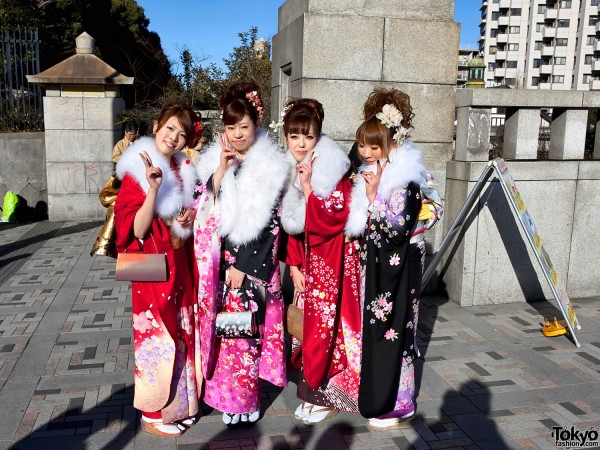
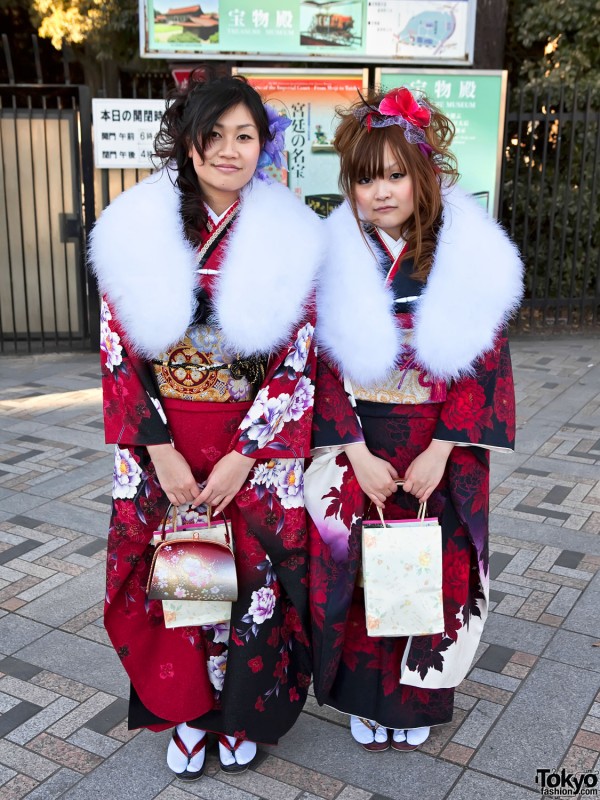
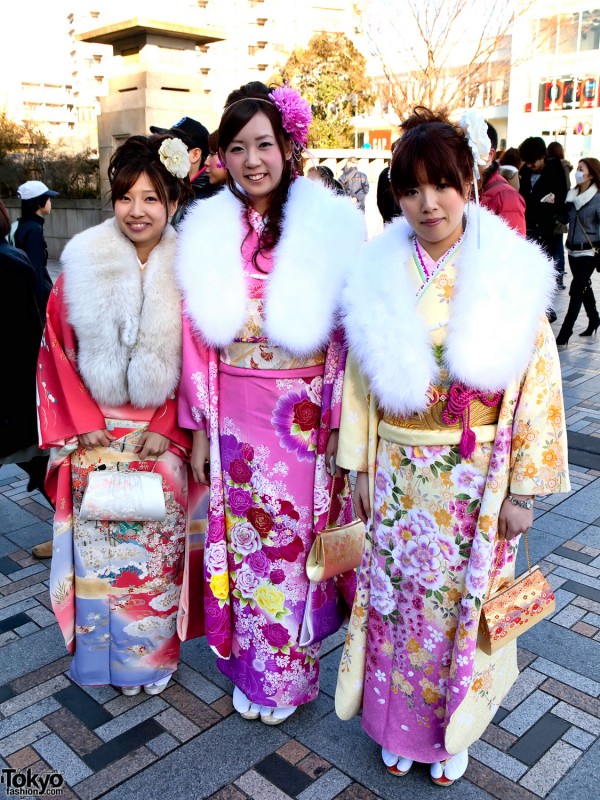
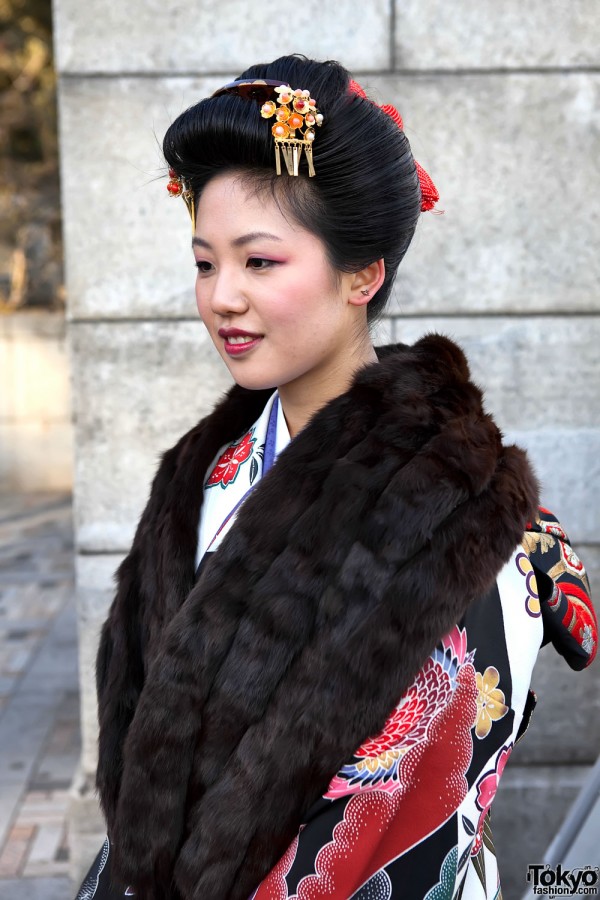
成人の日 or Coming of Age Day

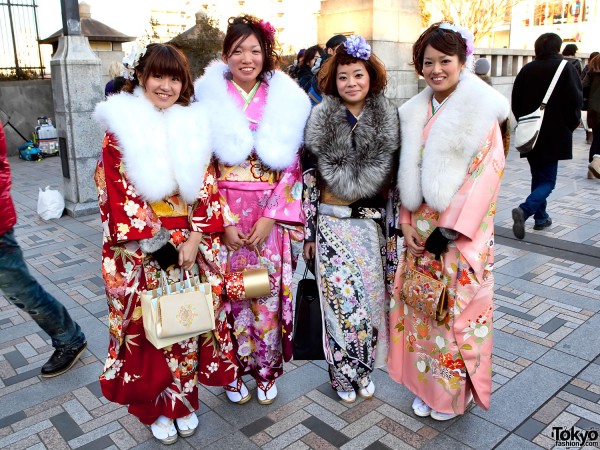
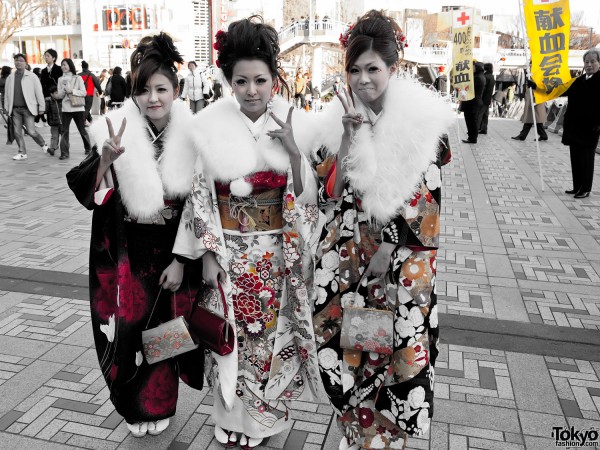
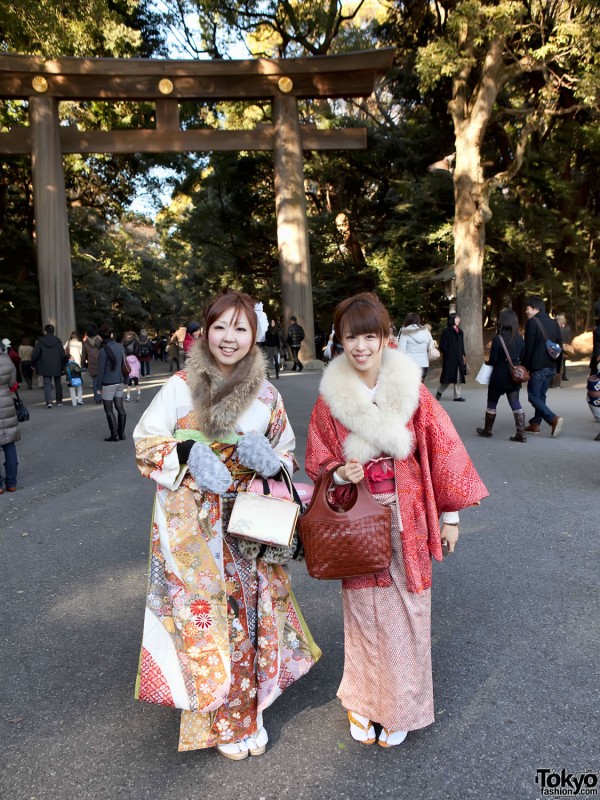
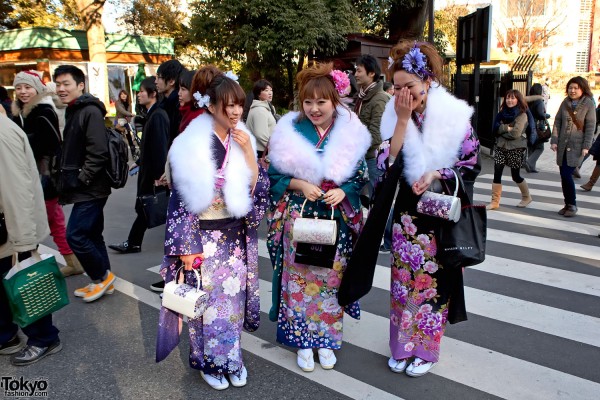
(all images provided in this post can be found over at Tokyo Fashion. Please check out their website for updates on all the fashion of Tokyo)

On January 10th of this year, local offices all over Japan held 成人式(seijin-shiki) or "Coming of Age Ceremonies" to celebrate the young men and women who have reached adulthood, or the age of 20. At the age of 20, it is legal to buy tobacco or alcohol products, vote, and you are henceforth considered a full-fledged adult.


The original "Coming of Age Day" was called "Genpukku" for boys and "Mogi" for women. Boys between the ages of 11 to 17 (the median age being 12) were taken to shrines and given their first adult set of clothes. Also, their hair was cut into a more adult style. The equivalent for girls also included the presentation of adult clothes. (wikipedia)

Nowadays, it's a day that both Japanese and non-Japanese alike look forward to.
For Japanese girls, it's very special because they wear furisode, a special type of kimono worn by unmarried women with longer sleeves than a traditional kimono. This symbolizes they are unmarried and an adult, and thus, are available for marriage. The kimono is usually rented, however, because they are very expensive. Girls also usually get their hair done, in both traditional Japanese and Western styles. They also usually hire someone to help them put on the kimono because it is so difficult!!! Young Japanese men usually wear western suits but some still opt for the traditional kimono with hakama. Often, the young Japanese get special photos taken for their family to commemorate this experience.

Tourists and gaijin living in Japan alike often blog or post pictures from this day, as this is something exclusive to Japan and one of the rare occasions where you can see a large group of Japanese people in traditional Japanese kimono!


Local city offices typically hold the ceremonies in the morning. They invite all of the local residents who will or have turned 20 between April 1st of the past year and March 31st of the upcoming year to celebrate this special achievement and to congratulate and encourage them in their adult lives.

This national holiday was established in 1948 and was originally celebrated every year on January 20th. However, in 2000 the date was changed to the second Monday in January.


Following the ceremony, many young people pray at shrines and then party with either friends or family to celebrate, often until the wee hours of the night!


Links with articles on Seijin no Hi
Tokyo Fashion's 2010 Seijin no Hi pictures
Tokyo Fashion's 2011 Seijin no Hi pictures
The Hub Pages's artcle "The Celebration of Seijin No Hi" 
Wanna Go To Japan's Article "The day of coming of age – 'Seijin no hi'” 
Billy Hammond's Article "Seijin no Hi"
Pictures from Seijin no Hi at My Tokyo Dream
Article about a Seijinshiki on-location shoot at Graphic Noise
Short post with puri from Seijin no Hi from Mechanical Doll


And now some pictures courtesy of Tokyo Fashion!

 Does your country celebrate when someone becomes an adult? Have you ever witnessed Seijin-shiki?


and as a final note, (as I always have in my posts) I am like 90% sure I am returning to Japan for two weeks in March! One of my best friends said I could stay with him and his family! Yay for not having to book hotels!!
Will you be around the Tokyo area? If so, lets meet!!!!!!!

i have a giveaway announcement next :]


Tuesday, November 30, 2010

Things I Learned in Japan: expectations lead to disappointments. [part 1]

This is going to seem ranty, and it in all honesty is, but it's something I feel needs to be discussed and I want to get it all off my chest before I freak.

I am a member of a forum for exchange students, and I've seen a lot of bashing of Rotary on the website. Some of it is warranted, but some of it is not. What really pisses me off, is that it is deterring potential future Rotary Exchange students from even considering Rotary because of how "irresponsible" they are. That's a crock of b.s. and I'm personally sick of it and how irresponsible exchange students just blame Rotary when much of their problems really were due to themselves and their expectations.


For those who don't know, I was a Rotary International Youth Exchange Student from District 7410 Northeastern Pennsylvania, United States of America to District 2820 Ibaraki-ken, Japan. More about RI's Youth Exchange can be found here.
Map of Ibaraki Prefecture


I left America at 10:15 AM on September 17th, 2009 and returned on August 17th, 2010. I lived in Kashima, Ibaraki for most of my exchange, but the last quarter was spent in Namegata, Ibaraki. I had five host families. I was sick often. I had to have a root-canal. I got hit by a car. I was left in a hotel for my first week. I had two host families that talked down to me and made me feel horrible. When I came to Japan, I had to wait for over an hour for someone to come get me. I was supposed to have a counselor, but I only met her twice. I was forced onto all of my host families. I was made fun of sometimes in school. My exchange was less than perfect.


My exchange was less than perfect, but I never once blamed it all on Rotary. Sure, some of it was Rotary's fault. Some of it was a culture problem. Some of it was irresponsibility of the people in Rotary. But if anything, it was Rotary Japan or my district's fault, not Rotary International as a whole.


With the 2-week exchanges from the Philippines. Love my derp face XD

For those unfamiliar with Rotary International Youth Exchange, I will explain it further.

Students are selected by Rotary Districts to do a one-for-one exchange to a foreign country - ie: one kid from a district in America goes to a district in Germany, one kid from that district in Germany goes to that district in America. However, some countries have only been allowed to send students due to concerns for their safety. Some districts have also been banned from youth exchange due to neglect or not following Rotary rules.


Communication with RIYE is primarily from District to District. That being said, whenever an issue arises, communication begins from higher up the food chain. However, if it can be handled District to District, that is the most ideal circumstance.


Within each club in Youth Exchange, there is a person assigned to be the Youth Exchange Counselor. If that club hosts students, that person is their counselor. If they send students abroad, that person is their club contact. My club in Japan changed 3 times (not allowed in Rotary rules, but whatev) so I essentially didn't have a counselor.


When I first came to Japan, I stayed in a hotel for a week. I essentially only slept there, but according to Rotary rules, that is a big no-no. Host families are supposed to be located and confirmed BEFORE the student arrives.


Host families were pretty much not found for me, other than my second which volunteered (I believe they did it for the money). Second hosts didn't like me very much, told my school how much I "hated" school, had no friends, was always skipping (I missed 3 days 'cause I was sick, I guess that's skipping), and that I needed to be "disciplined". That's where my 3rd hosts came in - I stayed with them for 20 days and they are just as close as family to me. They said to me on the second day, "You're nothing like what they told us". To which I found out about all that had been said about me. My 4th hosts were the same - they were asked to host me because the host mother was around a lot and could "keep an eye out on me". Yet again, we've become very close and they invited me back to their house many times. They even came and saw me off at Narita! My host mother also hugged me before I left - something which brought tears to my eyes.
above mentioned 4th hosts at Narita.


During this time, a lot of crap was still being talked about me within Rotary; about how "horrible" and "spoiled" I was, how I lacked any respect for Japan, and, that because I was "so bad" they couldn't find hosts for me (THAT is a total crock, I had many, many people offer to host me throughout my exchange, but because I had to change clubs, they couldn't. Also, the members of my last club weren't even asked!!!). Upon hearing this, my 5th host dad, who was not a member of Rotary, thought that I was being mistreated and said, "If you can't find a host family for her, she can stay at my house", to which the Youth Exchange Coordinator in my District in Japan simply stopped even trying to find a family - and also apparently forgot to tell those hosts I was even coming. [/embarrassment]


Overall, there was lack of accountability and willingness to do anything for me. But this is not Rotary International's fault. That I get. It is the fault of the people involved in Rotary in my district in Japan. If I had contacted my Rotary in America and said anything along the lines of, "I'm uncomfortable here," or "I feel like the Rotary here doesn't care about me" or anything of the sort, they would have taken the necessary actions to help me.


I was lucky that I have a very caring and involved Rotary District in America. Not everyone has that. However, I was told repeatedly throughout my orientations that Rotary is different in every country, and just because it is like this in America does not mean it will be like that in my host country. Here-again, it depends on the people within Rotary.


Rotary is not a bad organization. Some districts could really use some changing, but that's inevitable. You cannot go into an exchange through any program and expect them to be perfect! They are run by people! People make mistakes!


next part is coming later today or tomorrow and will focus on expectations of exchange students, host families, and of host countries by exchange students. Please check it out!


Sunday, October 10, 2010

Remembering my school life in Japan: Part 1(VERY PIC HEAVY)

I'm introducing my new series! It will be divided into a few parts and will be about my high school exchange in Japan!

Here's how I plan on dividing it up:

Part 1 - Introduction to my school and 2年2組 - My first homeroom

Part 2 - 2年3組 - My second homeroom
Part 3 - Events at school/daily life/being a gaikokujin seito
Part 4 - Relationships in Japanese High Schools
Part 5 - Public vs. Private High Schools
Part 6 - Random Memories

I may be adding more if I feel more ambitious, hah!

I've been having mood swings lately and I've decided to start by blogging about my exchange as a way to channel all this change of thought so the loneliness doesn't kill me. I miss Japan too much.


Part 1 - Introduction to my school & 2年2組, my first homeroom
I was a one-year exchange student at 清真学園高等学校(Seishin Gakuen Koutou Gakkou, link).
It's a private Junior/Senior High School located in Kashima, Ibaraki. Students from as far north as Mito, Ibaraki and as far south as Narita, Chiba come to this school.

It's considered one of the top schools in the area and has a strong Rugby team and Shorenjikempo club. In 2007, it was selected to be a "Super Science High School" meaning, for 3 years, they would get special funding, textbooks, and money for trips to further their school's studies all while relating it to science. Even our English textbooks were primarily about science.

There is about 1,000 students school-wide and has over 100 teachers. Two are Americans, both from Washington State and teach English. Many of the teachers are graduates of Tokyo University, Meiji, and other top Japanese universities, making it a very prestigious school.

I attended Seishin with the exchange student from Thailand. We were the first year-long exchange students in over ten years, so it was a very new concept at Seishin.
Even with three other foreigners, I was the ONLY person with light hair that wasn't grey, which made for some funny looks, but some great laughs.

The 11 months I spent there was amazing and I made tons of friends and tons of memories. So hopefully I can share some of that with my readers (if there are any, hah!)


My first homeroom was 2年2組 or 2nd year, 2nd class(same as 11th grade in America). There were 41 people + 1 gaijin.


 Class picture - from my LAST Long Home Room (where we had assemblies, played games, had study time, etc) as a 2-2er but it was so much fun!


I will always have a lot of love for this class because they put up with me when I couldn't speak Japanese at all.


(should go under memories, but time appropriate)
From Halloween last year. This was from a Halloween cookie container. It turned into a pumpkin mask.

We had a "Halloween Party" during lunch, but that just meant they MADE cookies. Stupid American me went out and made treat bags for my main friends and brought in candy for everyone else.

.......Halloween in Japan is not Halloween in America.
My friends and I all got matching back-packs from Uniqlo.

We took pictures of us all together, and then we vowed never to use them on the same day because it was too embarrassing (so they said).

I gave mine to my last host sister because I couldn't fit it in my suitcases :[ But I will always have this lovely picture to remember them by♥


This is the one-week exchange student we had . She was staying in Tokyo originally but came to visit us for a week and she was SO COOL!

She helped me with my Japanese some, which I'm really thankful for.


Random picture from lunch. This girl became my BEST friend from this class.

She and I sang anime theme songs in karaoke... a few times! haha. She was a secret otaku.
 My shadow buddy!
She had to show me around a lot during my first month.

We, sadly, didn't stay very close at all. She became tired of having to "take care" of me, I think. Would someone like a blog about the pressures of being an exchange student vs being an exchange student's friend vs being a host family? I think it's a very interesting topic that I'd LIKE to write about.


 My group of friends at our bbq!


me and my two friends in our horribleeee winter uniforms. DEFINITELY not meant for white girls.


it started SNOWING but we still had the bbq.


The boys, hiding under umbrellas, and all trying to "sneak" into my shots without making it obvious. They were so cute.


The people in this class were very, very, very shy. The boys would run up and "test their English skills", sometimes ignore, and made my gaydar go off many times before I realized it was just a difference in culture. The girls were sweet, but since they were very rich, were pretty into labels.


I had 7 girls in this class who I ate lunch with, had all my classes with, and relied on for a long time. However, I think they had some issues between them that, due to my lack of Japanese cultural awareness/lack of language ability, were never explained to me and I'm not really sure why we kind of "split up" right before spring break. Sometimes I think it might have had something to do with me..... *sigh*


Do YOU guys have any questions about this class? Or any questions about Japanese high schools in general? I'm willing to answer anything so feel free to ask, ask away~! Maybe I'll add in a Q&A page for this series?


I'll try to update tomorrow as well, hopefully with a coordinate post as well. :]